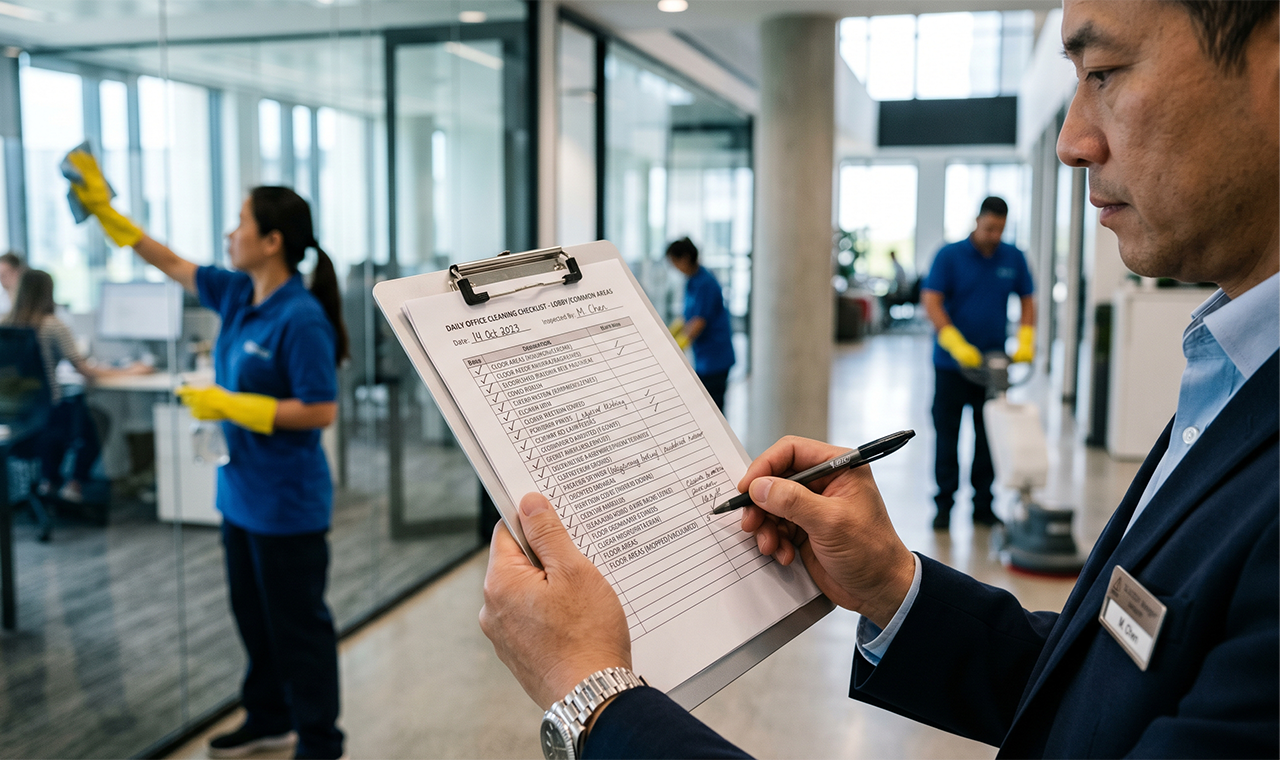
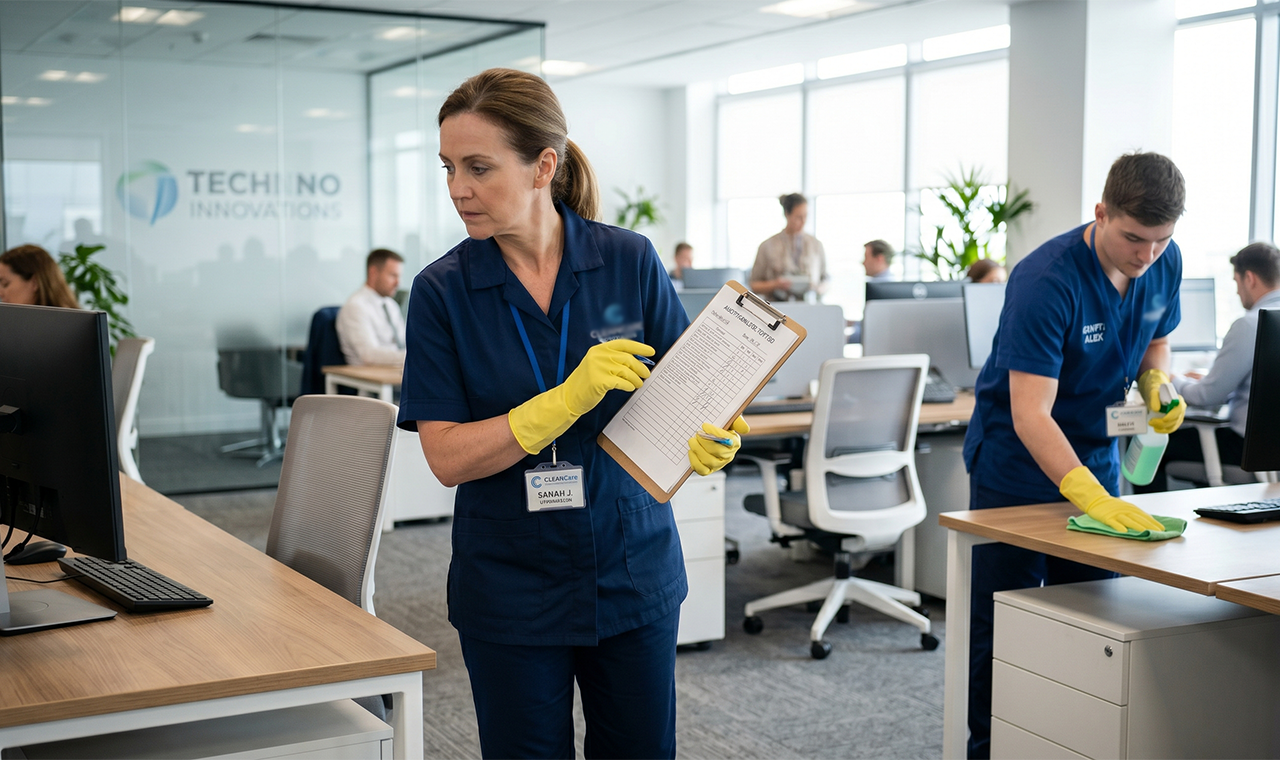
Commercial office cleaning involves repeatable tasks delivered across multiple areas of a building. These controls form part of structured daily-contract-cleaning programmes where supervision and compliance are defined before mobilisation. An office cleaning method statement explains how those tasks will be carried out safely whilst meeting compliance standards.
An office cleaning method statement is a site specific compliance document required under UK health and safety law. It explains how cleaning tasks will be delivered, how risks are controlled, and how supervision is structured. Facilities managers rely on it to verify legal compliance before contract award.
It is submitted alongside RAMS during procurement, outlining job steps, risk controls, and supervision planning. For clients, it provides evidence of scope of coverage, safety measures, and quality control standards before a contract is signed.
TL; DR: Office cleaning method statement UK
- Confirms cleaning scope and safety before signing contracts.
- Submitted with RAMS during procurement checks.
- Must include COSHH, SDS, supervision, and audits.
- Buyers should check dilution rules and snag logs.
- A site survey confirms scope and warning signs before starting.
If an office cleaning method statement is poorly prepared, it can lead to safety incidents, compliance breaches, service failures, and avoidable legal or financial risk.
When Is an Office Cleaning Method Statement Required?
An office cleaning method statement is required when cleaning activities introduce identifiable risk.
This includes:
- Cleaning during occupancy
- Multi site commercial contracts
Under the Health and Safety at Work Act 1974, contractors must demonstrate suitable and sufficient risk control.
Procurement teams typically require RAMS before contract award, site mobilisation, or permit to work approval.
If a contractor cannot provide site specific RAMS, do not proceed.
What Is an Office Cleaning Method Statement?
An office cleaning method statement is a site specific compliance document that explains how cleaning tasks will be delivered safely within a commercial building.
It defines:
Contractors submit it alongside a risk assessment as part of RAMS during procurement.
For facilities managers, it proves one thing. The contractor has assessed the building properly and built a structured delivery plan. It is not a marketing document. It is a legal and operational control document.
If it lacks building specific detail, it fails compliance expectations.
Method Statement vs Risk Assessment (What Is RAMS in Cleaning?)
RAMS is a risk assessment statement submitted with a method statement. The two documents serve different purposes.
If both documents are not aligned properly, it signals a weak plan and gaps in compliance with clients before the contract starts.
UK Legal Requirements for Office Cleaning Method Statements
Office cleaning method statements must align with UK statutory duties. Procurement teams should verify compliance with the following legislation:
- Health and Safety at Work etc. Act 1974
- Management of Health and Safety at Work Regulations 1999
- Control of Substances Hazardous to Health Regulations 2002
- Workplace Health, Safety and Welfare Regulations 1992
- Reporting of Injuries, Diseases and Dangerous Occurrences Regulations 2013
- UK REACH requirements for Safety Data Sheets
Under Section 3 of the Health and Safety at Work Act, contractors must protect employees and non-employees affected by their work activities. A suitable and sufficient risk assessment is a legal requirement.
Facilities managers should request evidence of review dates, competent sign off, and alignment between identified hazards and control measures. A generic document without site specific risks does not meet statutory expectations.
What Clients Should See Inside Method Statement?
A compliant office cleaning method statement must prove control, supervision, and measurability.
Buyers should see:
- Defined cleaning scope by zone and frequency
- Linked hazards and control measures
- COSHH assessments and SDS references
- Named supervisors and audit frequency
- Snag reporting and escalation process
If the document cannot demonstrate these clearly, request clarification before contract award.
It should reference COSHH procedures, SDS documentation, slips and trips controls, and practical safeguards such as dilution control and contact time requirements. Supervision, training records, and corrective action processes should also be defined.
The scope section should clearly define office cleaning services for which areas are cleaned daily, weekly, or periodically.
Below table shows what each section of a method statement should prove during a compliance review:
COSHH and Chemical Control Check
Every office cleaning method statement should contain a clear COSHH section. Buyers must confirm that hazardous cleaning products have supported COSHH assessments and up-to-date Safety Data Sheets (SDS).
The document should explain how chemicals are stored, labelled, and accessed on site. It must define dilution control, required contact time, and mandatory PPE for safe handling. Spill response procedures and restricted storage areas should also be documented.
For procurement teams, this section confirms legal compliance and operational discipline. Missing COSHH files, unclear dilution instructions, or outdated SDS documentation indicate compliance gaps and increased risk before cleaning even begins.
Buyers should confirm COSHH assessments are reviewed at least annually or when products change. Each assessment must define hazard classification, exposure routes, control hierarchy, first aid response, and spill procedures.
The Control of Substances Hazardous to Health Regulations 2002 require employers to prevent or adequately control exposure to hazardous substances. Failure to evidence compliance exposes both contractor and client to enforcement action.
Colour Coding and Cross-Contamination Controls
An office cleaning method statement should clearly explain how cross-contamination is prevented across different areas of the building. This is especially important in washrooms, kitchens, and high-touch zones.
The document should define a recognised colour coding system, ensuring separate cloths and mop heads are used for toilets, sinks, food areas, and general surfaces. It should also outline equipment segregation, safe storage, and laundering procedures for reusable materials such as a microfibre system.
For buyers, this section confirms that hygiene standards are controlled, not assumed. If colour coding is not defined or staff responsibilities are unclear, it increases the risk of contamination, complaints, and service failure during the contract.
Room-by-Room Method Statement Checklist
A detailed office cleaning method statement should break tasks down by room or zone. Buyers should be able to see exactly what is cleaned, how often, and what controls apply in each area.
If the document only lists general tasks without linking them to specific spaces, performance becomes difficult to measure after contract award.
Below is a checklist clients can use during compliance review.
Get a free site visit and quote.
Slips and Trips Controls During Cleaning
Slips and trips remain one of the leading causes of workplace injury in the UK. Floor cleaning increases that risk.
An office cleaning method statement must define clear controls, including:
- Wet floor signage placement rules
- Restricted access zones during cleaning
- Cleaning outside peak occupancy hours
- Correct dilution of floor chemicals
- Defined drying time before reopening areas
- Safe cable management for equipment
Vague statements such as “wet floor signs will be used where necessary” are not sufficient.
The Health and Safety Executive treats slip incidents as preventable. Poor documentation increases liability exposure for both contractor and client.
Clear procedure reduces enforcement risk and protects building occupants.
Supervision, Audits and Snag Closure
A strong office cleaning method statement should clearly define how the contract will be supervised and monitored. Buyers should expect a named supervisor, scheduled supervisor checks, and a structured audit process.
The document should outline audit frequency, scoring criteria, and reporting format. It must also explain how issues are recorded in a snag log, how corrective action is implemented, and how escalation is managed if standards are not met. References to staff training records and regular toolbox talks demonstrate oversight and accountability.
For procurement teams, this section confirms that performance will be measured, not assumed. Here’s an example of Audit Scorecard checklist:
Cleaner Competence and Training Requirements
A compliant method statement must define operative competence and supervision capability. Buyers should request documented evidence of:
- Working at height training where applicable
- Lone working risk assessment and procedures
- Supervisor competency records
Training records must match the hazards identified in the risk assessment. If the method statement references chemical handling or high level cleaning but provides no training evidence, it creates a compliance gap.
Competence directly impacts risk scoring. Contractors should demonstrate structured inductions, refresher training schedules, and toolbox talks recorded in supervision logs.
Supplier Document Pack Checklist (Tender Evaluation)
During procurement, buyers should request a structured supplier document with cleaning contract pricing, alongside the method statement. This confirms compliance before the contract award.
If any of these documents are missing, outdated, or generic, it signals weak compliance control before the start of work.
Environmental and Waste Compliance Controls
Office cleaning contractors must manage waste under the Environmental Protection Act 1990.
A compliant method statement should confirm:
- Waste segregation by type
- Licensed waste carrier details
- Waste transfer note process
- Hazardous waste documentation where applicable
- Retention period for waste records
- Chemical discharge control procedures
- Sustainable product selection policy
Facilities managers should verify waste carrier registration and request copies of waste transfer notes during mobilisation.
Environmental compliance supports ESG reporting and protects against regulatory penalties.
If waste handling is not documented clearly, it signals operational weakness.
Red Flags in Office Cleaning Method Statements
A method statement should be site-specific and measurable. Generic documents create risks.
If the document reads like a template copied across multiple sites, performance and accountability may be unreliable.
Compliant vs Non-Compliant Method Statement
A compliant method statement:
- Links each hazard to a defined control measure
- Names responsible persons
- Defines supervision frequency
- Includes COSHH references and dilution controls
- Specifies review dates and authorised signatures
A non-compliant method statement:
- Omits building specific risks
- Lacks supervision structure
- Does not reference COSHH assessments
- Contains no audit or escalation process
Procurement teams should reject template based submissions that fail to demonstrate site understanding.
How to Review a Method Statement in 10 Minutes
Procurement teams often need a quick compliance check. Use this simple review process.
If any of these are unclear, request clarification before contract award.
FAQs About Office Cleaning Method Statement
Request a Sample Office Cleaning RAMS Pack
Before awarding a contract, review a structured, site specific RAMS example.
We provide:
- Building specific method statements
- Named supervision structure
- Documented snag escalation process
Request a sample RAMS pack or book a site survey to receive compliant documentation tailored to your premises.