

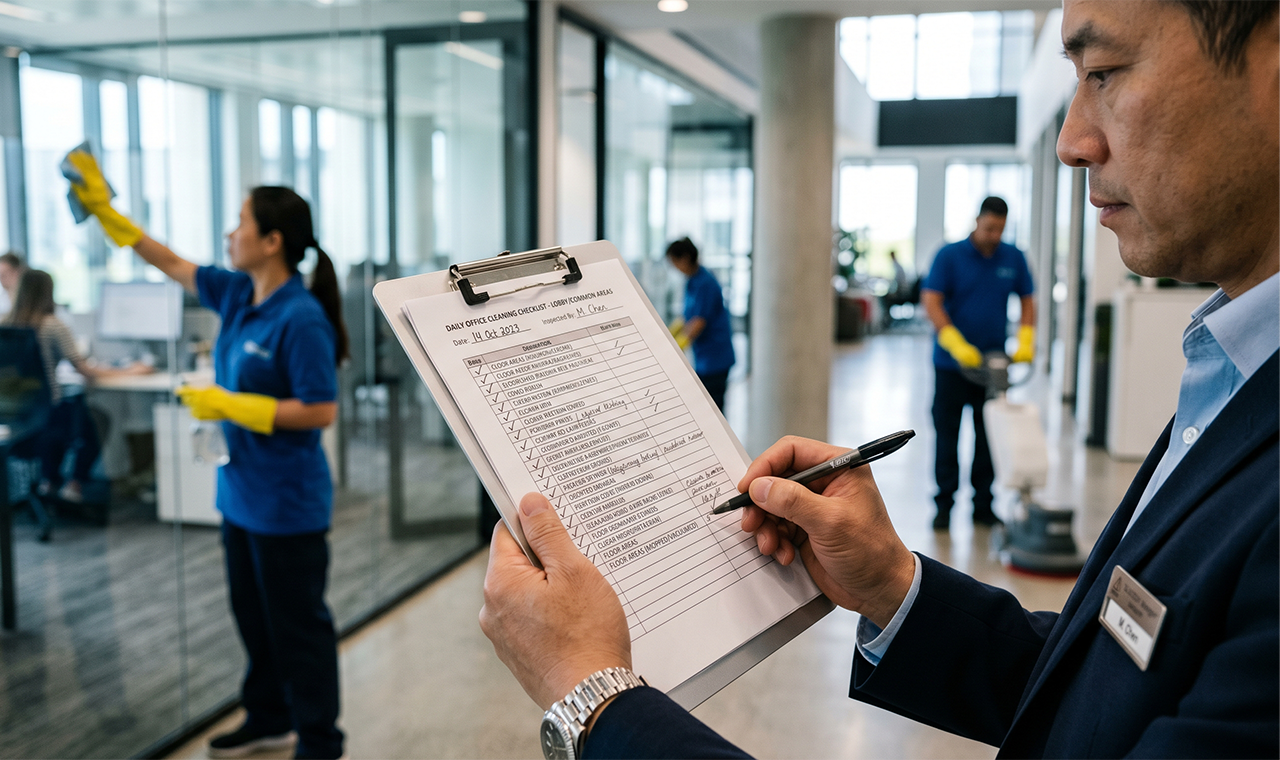
You can tell within a week when a cleaning programme isn’t holding. Overflowing bins by the lifts, smeared glass in reception, a washroom out of towels by mid-morning.
Home > Insights & News > Daily Cleaning Checklist for Commercial Buildings: Room-by-Room Standards
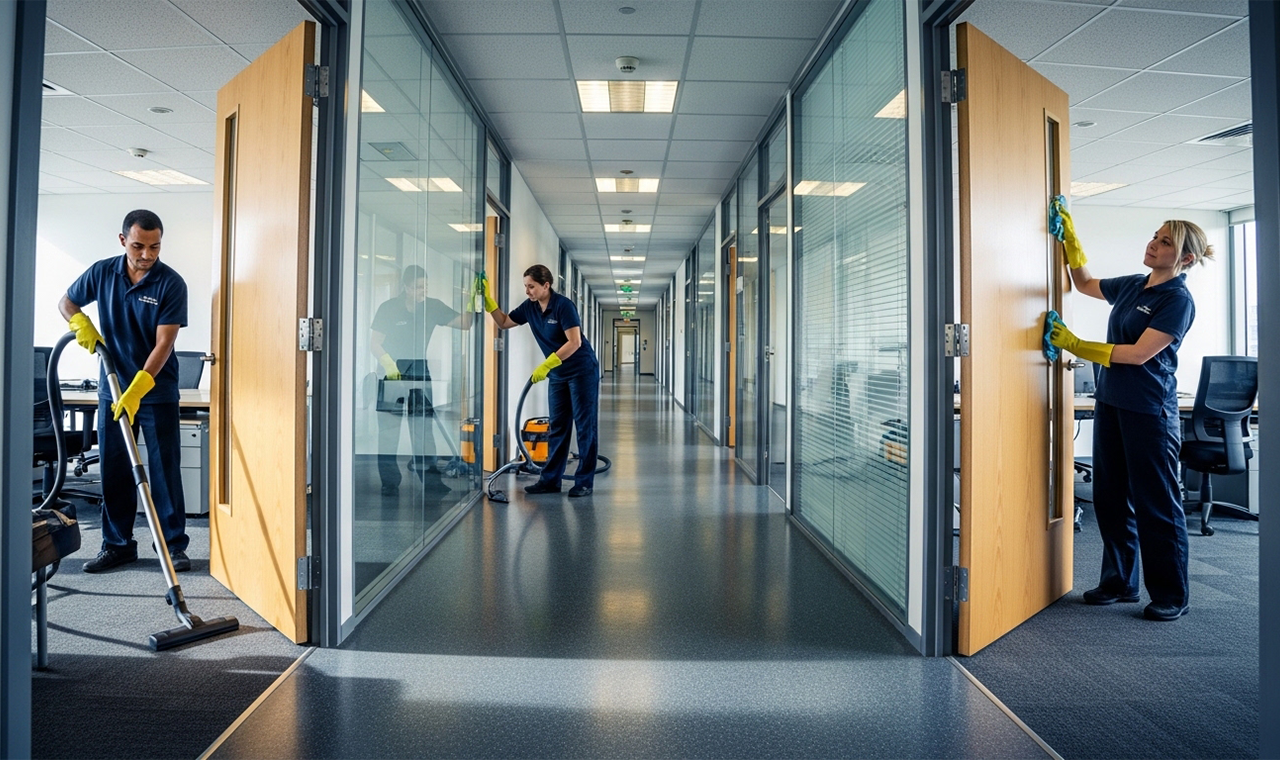

A documented daily cleaning checklist for commercial buildings is the foundation of any effective cleaning specification. Without a clear structure, standards vary, tasks get missed, and accountability becomes difficult to maintain. Whether you manage cleaning in-house or oversee a contractor, understanding what daily cleaning should include is essential for maintaining consistent workplace standards.
In the UK, expectations around workplace cleanliness go beyond operations and connect directly to compliance. Guidance from the Health and Safety Executive (HSE) and the Workplace (Health, Safety and Welfare) Regulations 1992 require employers to keep environments clean, safe, and hygienic.
This room-by-room guide provides a ready-to-use checklist aligned with industry standards, helping you define daily cleaning duties clearly. The Clean Space has supported over 150 commercial sites across the UK with structured cleaning programmes built on these exact standards.
A daily cleaning checklist for commercial buildings is a structured document that defines cleaning tasks, frequencies, and standards for every area of a workplace. It covers reception areas, offices, kitchens, washrooms, meeting rooms, corridors, and high-touch points. In the UK, daily checklists align with HSE guidance and Workplace (Health, Safety and Welfare) Regulations 1992 to maintain hygiene, safety, and compliance.
A standardised daily cleaning checklist for commercial buildings ensures your team delivers cleaning consistently, regardless of who is on site. Without a defined structure, standards vary between cleaners and across shifts, leading to missed tasks, inconsistent hygiene levels, and increased complaints.
Maintaining a clean workplace is a legal requirement in the UK. Under the Workplace (Health, Safety and Welfare) Regulations 1992, employers must ensure premises remain sufficiently clean. The Health and Safety at Work Act 1974 places the overarching duty of care on employers, while HSE guidance reinforces the need for structured cleaning processes, particularly in shared environments.
A documented checklist improves accountability. Clearly defined tasks allow you to track progress using cleaning logs, sign-off sheets, and cleaning audits, creating a transparent audit trail. This is especially important in contract cleaning, where you measure performance against agreed cleaning specifications and service standards.
A clean workplace directly impacts employee wellbeing. Research from the British Institute of Cleaning Science (BICSc) suggests that well-maintained environments can reduce sickness absence by up to 30%, particularly when teams sanitise high-touch areas regularly in line with COSHH guidelines.
A daily checklist forms a core part of your cleaning specification, ensuring clarity between client and contractor. It defines exactly what “daily cleaning” includes, reducing ambiguity and enabling consistent service delivery across the entire commercial building. For a more detailed breakdown, see our office cleaning method statement for the UK.
Reception and entrance areas create the first impression of your building and experience the highest foot traffic. Daily cleaning here should focus on presentation, hygiene, and high-touch point sanitisation to maintain commercial cleaning standards and reduce the risk of cross-contamination.

Monitor high-traffic entrance areas throughout the day. In larger commercial buildings, provide additional daytime cleaning support to maintain standards between scheduled cleans.
A well-maintained reception area reflects your organisation’s standards and supports a cleaner, safer environment from the moment people enter the building.
Open-plan offices are where most employees spend their time, making them a priority for daily office cleaning tasks and hygiene control. With shared desks, equipment, and frequent movement, these areas require consistent cleaning to maintain workplace cleaning standards and reduce the spread of germs, especially in hot-desking environments. For a London-specific version, see our office cleaning checklist for London workplaces.

In hot-desking environments, provide enhanced sanitisation between users to reduce cross-contamination. This may require additional daytime cleaning or user-led hygiene protocols. Use microfibre cloths for surface wiping to improve dust capture and reduce chemical use.
Consistent cleaning in open-plan offices supports employee health, reduces absenteeism, and maintains a professional working environment aligned with modern commercial cleaning standards. The Clean Space delivers daily office cleaning services across the UK using structured checklists like this one.
Daily kitchen cleaning in a commercial building covers worktops, sinks, appliances, floors, bins, and consumable replenishment. Food preparation, shared appliances, and frequent use make kitchen and breakout areas a common source of hygiene complaints if your team does not clean them properly. Daily cleaning here must follow strict commercial cleaning standards and align with COSHH regulations to ensure safe handling of cleaning products.

Kitchen areas consistently rank as the highest complaint zones in workplace surveys. Without a structured cleaning schedule, hygiene issues can escalate quickly, affecting both employee satisfaction and compliance.
Maintaining cleanliness in kitchen areas protects employee health, reduces cross-contamination risks, and ensures your workplace meets required hygiene and safety standards.
Washrooms require the highest level of attention in any daily cleaning checklist for commercial buildings. Due to constant use and exposure to bacteria, you must clean and sanitise these areas thoroughly to meet workplace hygiene standards and comply with COSHH Regulations 2002.
Proper cleaning in washrooms goes beyond appearance. It prevents cross-contamination and maintains a safe environment for all users. Professional cleaning teams follow a strict colour-coded cleaning system, using red cloths and equipment exclusively for washroom areas.

Always carry out washroom cleaning using dedicated equipment and colour-coded cloths (red). Never use washroom cleaning tools in other areas of the building to prevent cross-contamination.
Maintaining high standards in washrooms protects employee health, reduces complaints, and ensures compliance with UK workplace hygiene regulations and cleaning best practices.
Meeting rooms and boardrooms are high-visibility spaces used for internal discussions and client-facing interactions. Cleanliness here directly reflects organisational standards, so focus daily cleaning on presentation, hygiene, and maintaining a professional environment.

Clean and well-maintained meeting spaces support productivity, create a positive impression for visitors, and reinforce professional workplace standards.
Clean corridors, stairwells, and lifts daily to maintain consistent standards and reduce slip hazards in high-traffic zones. These areas experience continuous foot traffic and include multiple high-touch points that contribute to cross-contamination if your team does not sanitise them properly.

Clean, well-maintained walkways reduce slip and trip risks and support compliance with workplace safety standards, particularly in high-traffic environments. Use HEPA vacuum cleaners in corridors to improve air quality and reduce dust circulation.
Maintaining these transitional areas ensures a consistent standard throughout the building, supporting both hygiene and safety while reinforcing a professional environment.
High-touch points are the most frequently contacted surfaces in any commercial building and are a primary source of cross-contamination. A structured sanitisation schedule is essential to maintain hygiene standards and support workplace health, particularly in shared environments. This is a critical part of any daily cleaning checklist for commercial buildings in the UK.
In line with modern commercial cleaning standards and COSHH guidelines, sanitise high-touch surfaces at least twice daily, adjusting frequency based on usage. For more guidance, read our article on how often an office should be cleaned in the UK.

Use appropriate disinfectants that comply with COSHH Regulations 2002, ensuring safe handling, correct dilution, and proper storage of cleaning chemicals. Staff should wear appropriate PPE and follow risk assessments when carrying out sanitisation tasks. All tasks should align with ISO 9001 quality management standards where the cleaning provider holds certification.
Regular sanitisation of high-touch points significantly reduces the spread of germs, supports employee wellbeing, and helps maintain a hygienic, compliant workplace environment.
We have created a downloadable PDF version of this daily cleaning checklist for commercial buildings, formatted as a printable room-by-room sign-off sheet.
Use it to:
This checklist covers the standard daily cleaning tasks for most UK commercial buildings. Every building is different, and your cleaning specification should reflect your layout, usage patterns, and compliance requirements.
When you request a site survey from The Clean Space, you receive:
Request a free site survey and get your building-specific cleaning specification.
Or let The Clean Space delivers this standard daily. We provide daily contract cleaning services across the UK, with structured checklists, supervisor oversight, and quality audits built into every contract.
A daily office cleaning checklist should cover floors (vacuuming or mopping), desk and surface wiping, bin emptying, washroom sanitisation, kitchen cleaning, and high-touch point disinfection. Each task should have a defined frequency and a sign-off process to maintain consistent workplace cleaning standards.
Yes. The Clean Space provides a free downloadable commercial cleaning checklist template aligned with cleaning specifications and UK industry standards. It helps ensure consistency, compliance, and clear task accountability across all building areas.
A washroom cleaning checklist includes cleaning and sanitising toilets, urinals, and sinks, wiping mirrors, mopping floors with disinfectant, replenishing soap and paper supplies, emptying sanitary bins, and descaling taps. All tasks must follow COSHH guidelines, and teams must use colour-coded cloths (red for washrooms only) to prevent cross-contamination.
The steps of cleaning in a commercial building follow a structured sequence: preparation and hazard check, dusting surfaces top-to-bottom, waste removal and bin replacement, surface cleaning and disinfecting, floor cleaning (vacuum then mop), consumable replenishment, and final inspection with sign-off. This process aligns with BICSc cleaning methodology.
Clean high-touch points such as door handles, light switches, and lift buttons at least twice daily, or more frequently in high-traffic environments. Post-pandemic best practice recommends sanitisation after peak usage periods (e.g. lunchtime, shift changes) as a minimum standard.
A daily cleaning checklist ensures consistency, supports compliance with HSE guidance, improves hygiene standards, and provides accountability through structured cleaning processes and audits.
Under the Health and Safety at Work Act 1974 and Workplace (Health, Safety and Welfare) Regulations 1992, employers hold primary responsibility for maintaining a clean and safe working environment. In practice, most commercial buildings delegate daily cleaning to a contract cleaning provider who operates under a formal specification with defined tasks, audits, and accountability.
A structured checklist only works when your team delivers it consistently. If maintaining these standards in-house has become difficult, a professional cleaning provider ensures accountability, compliance, and consistent results across your building.
The Clean Space has supported commercial clients for over 22 years, operating across 150+ sites with local teams, Living Wage employment, and ISO 9001 and ISO 45001 certification. Every contract includes structured daily checklists, supervisor oversight, and a quality guarantee.
Request a no-obligation contract cleaning quote today.

Wesley Smith is the Sales and Marketing Director at The Clean Space UK. He brings nearly 20 years of hands-on industry experience and a strong understanding of commercial strategy within professional hygiene services. As he puts it, “a strong brand is one that delivers the same experience it communicates in its messaging and content.
You can tell within a week when a cleaning programme isn’t holding. Overflowing bins by the lifts, smeared glass in reception, a washroom out of towels by mid-morning.
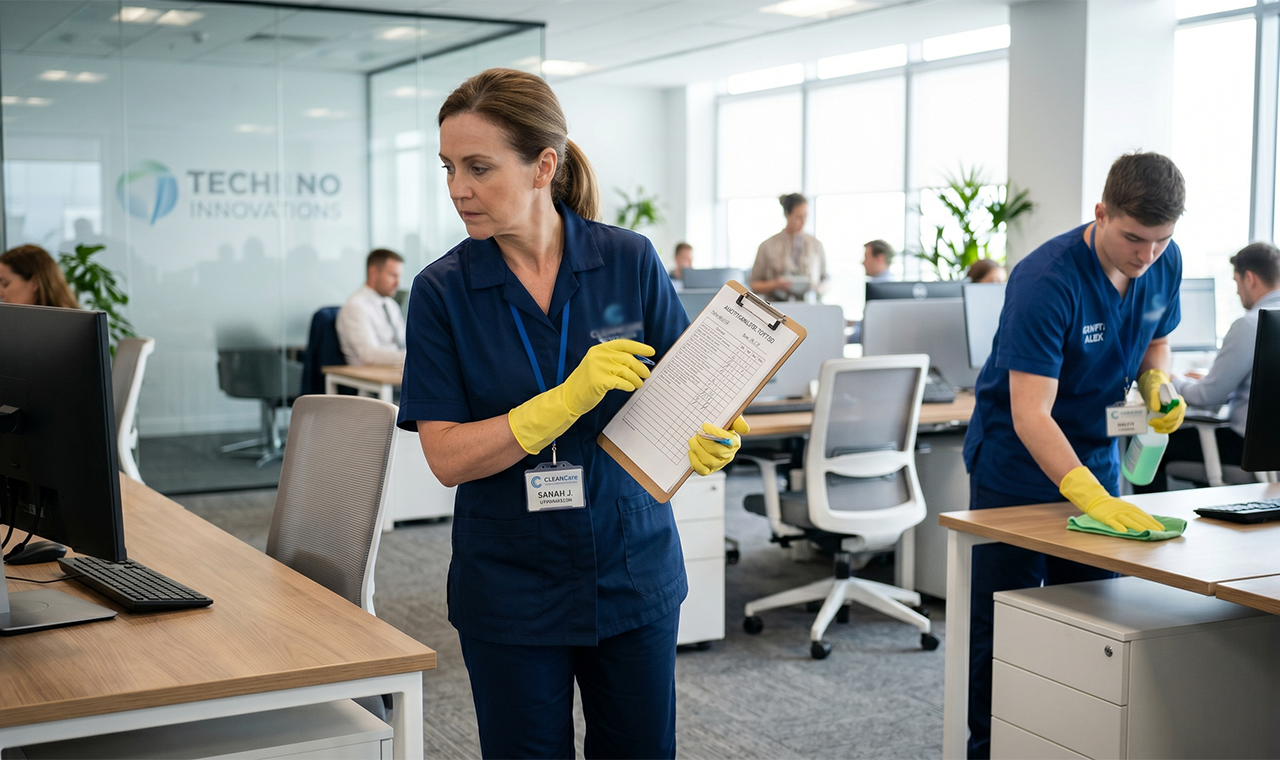
Most facilities managers never see a cleaning audit happen. A report arrives, it shows a score, and the contract carries on.
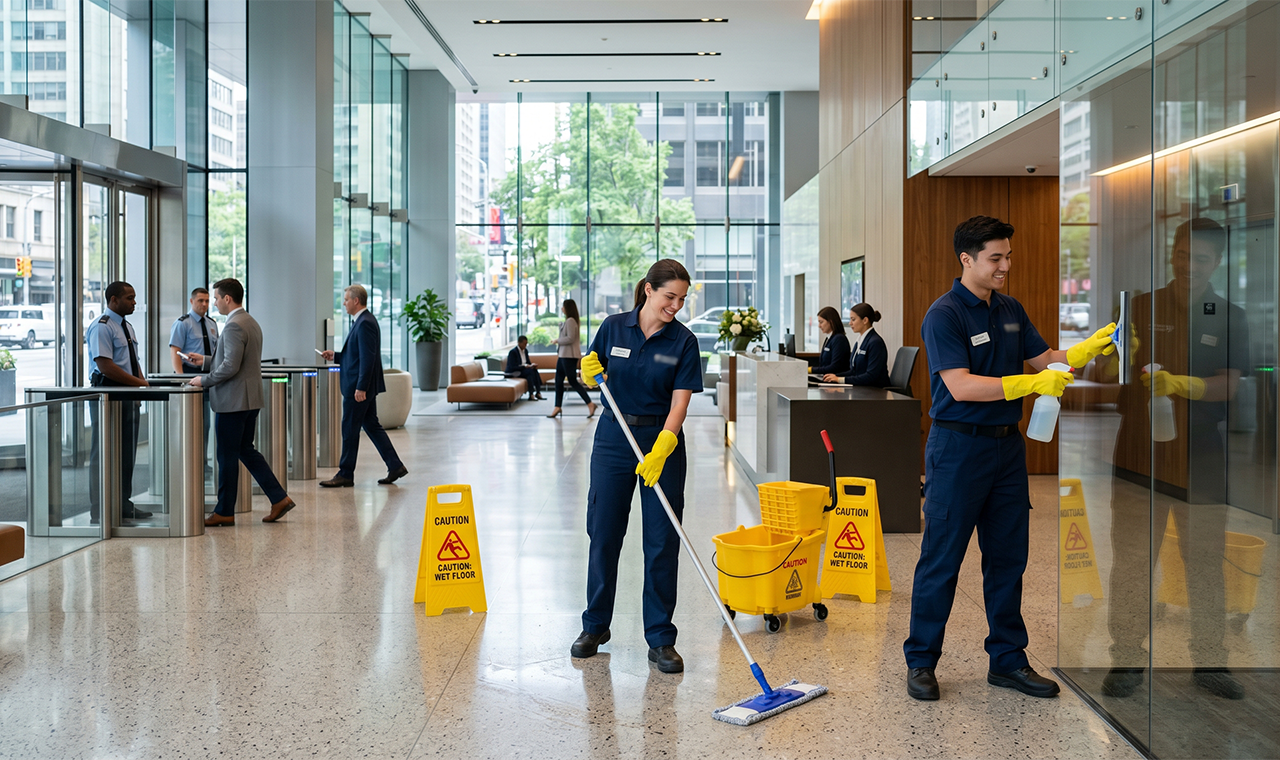
Commercial cleaning is a soft facilities management service, and it’s the most visible one your building has.
Cleaning Quote