

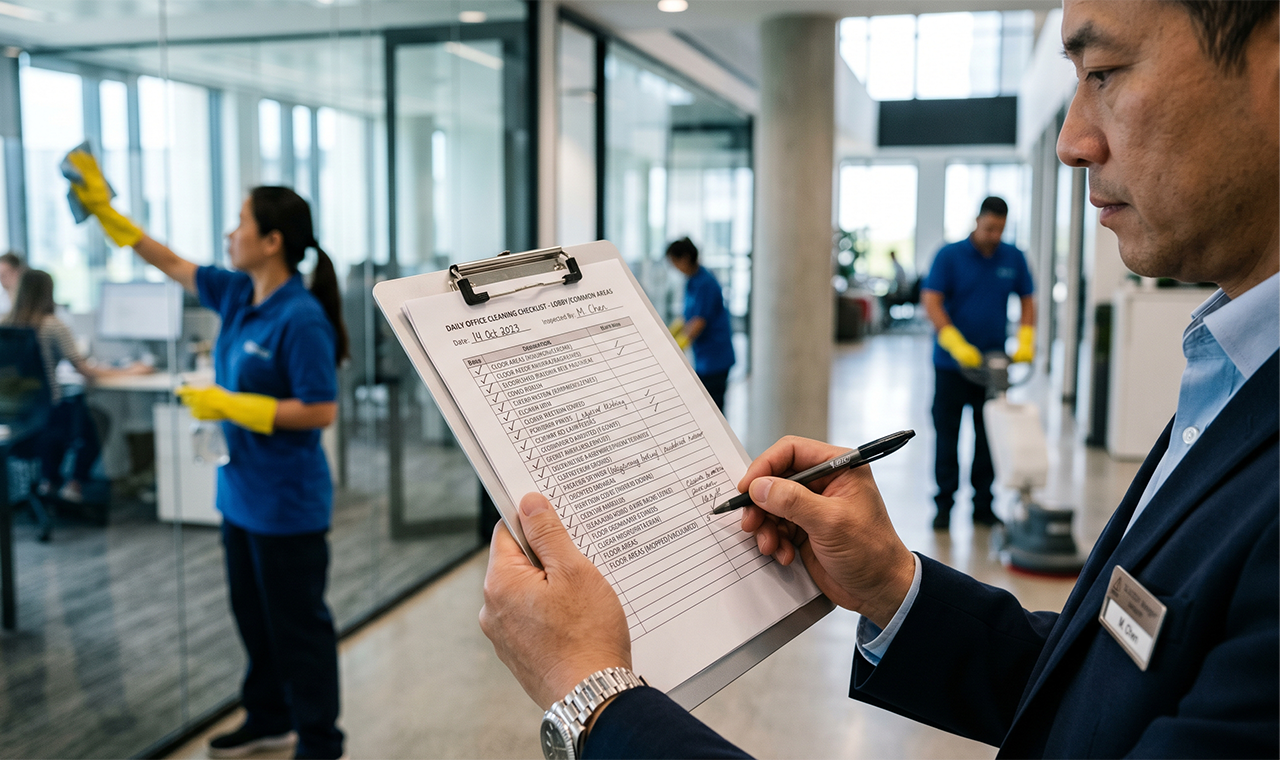
You can tell within a week when a cleaning programme isn’t holding. Overflowing bins by the lifts, smeared glass in reception, a washroom out of towels by mid-morning.
Home > Insights & News > Commercial Cleaning Cost Per Hour in London


The commercial cleaning cost per hour in London varies based on your site type, size, and cleaning frequency. Hourly rates are used as an initial estimate, not a fixed price. Most professional cleaning companies confirm the final cost after a site survey to assess scope, compliance needs, access times, and workload accurately.
“Per hour” pricing means you are charged based on the labour hours required to clean your site, not a guaranteed flat fee.
It is a costing benchmark used during quoting, especially for offices, retail units, and multi-site premises.
What it includes:
What it does not automatically include:
Hourly pricing allows cleaning providers to estimate workload before translating it into a fixed monthly contract after a survey, especially for businesses using our commercial cleaning services in London.
Hourly rates help plan costs, but they are not the price you ultimately pay. Final figures depend on scope confirmation.
In 2026, the average commercial cleaning cost per hour in London typically falls within a broad benchmark range, depending on site type, frequency, and compliance requirements. These figures are indicative only and are refined after a site survey.
These are planning benchmarks, not final contract prices.
Hourly benchmarks are used to:
They do not account for site-specific variables such as:
Costs increase when:
Costs stabilise when:
Professional cleaning companies in London do not lock hourly rates without:
This is why final pricing is almost always confirmed after a site survey, even when hourly benchmarks are discussed upfront.
Mini summary:
London hourly cleaning costs provide a useful reference point, but accurate pricing depends on how your site actually operates day to day.
Discussion around commercial cleaning quotes and price confusion.
UGC example
“Every company gave an hourly rate. The price only made sense after they walked through the site.”
Source: Reddit, UGC Reddit – r/australia
Takeaway:
Hourly rates start the discussion. They do not reflect workload. Final pricing depends on site size, access, frequency, and on-site conditions.

Commercial cleaning hourly rates vary in London because no two sites require the same amount of labour, supervision, or compliance control. The difference is driven by how your site is used, not just its size.
Cleaning requirements differ significantly between:
Multiple floors, stairwells, shared washrooms, and reception areas all increase labour time.
Rates are influenced by how often cleaning is required:
Consistency reduces setup time and improves efficiency.
Higher footfall leads to:
Sites open to the public generally require more labour per hour than controlled-access offices.
Some sites require additional controls, such as:
These requirements affect cost even if visible cleaning time appears similar.
London-specific factors include:
Access inefficiencies increase billable labour time.
Hourly cleaning rates depend on:
You can stabilise costs by:
Mini summary:
Hourly cleaning rates vary because labour, access, and compliance vary. The more predictable your site conditions, the more stable your costs become.
Direct answer:
Hourly cleaning works for short-term or variable needs. Fixed monthly contracts are more cost-effective for ongoing, predictable cleaning requirements.
Hourly pricing is typically suitable when:
Pros
Cons
Monthly contracts are usually preferred when:
Pros
Cons
Most professional cleaning providers follow this process:
This approach balances flexibility with cost certainty.
Mini summary:
Hourly cleaning offers flexibility, but fixed monthly contracts deliver better value and consistency for most London businesses.
UGC example
Facilities manager discussing the shift from hourly cleaning to a fixed contract.
“Hourly sounded cheaper at first, but the monthly contract ended up easier to manage.”
Source:Reddit – r/UKBusiness
Takeaway:
Hourly pricing can feel flexible, but fixed contracts reduce admin, surprises, and re-quoting once the scope is clear.
Direct answer:
A professional site survey turns estimated hourly pricing into an accurate, defensible cleaning cost by confirming scope, access, and compliance requirements on-site.
A proper commercial cleaning survey typically reviews:
This information cannot be accurately captured through phone quotes alone.
Hourly rates often shift because surveys reveal:
These factors affect workload, even if the site size appears small.
During a survey, providers also confirm:
COSHH is used as a safety framework, not a certification, to ensure cleaning is carried out responsibly.
Once the survey is complete:
This reduces disputes, re-quoting, and unexpected cost increases.
If you want predictable cleaning costs:
Mini summary:
Site surveys replace assumptions with facts. They protect both parties and lead to stable, transparent pricing over time.
Hidden costs in commercial cleaning usually appear when the scope is unclear, access is restricted, or compliance requirements are not documented upfront.
These costs are often excluded from initial hourly quotes unless stated clearly:
Be cautious if a provider:
Low upfront pricing often leads to higher long-term costs.

Mini summary:
Hidden costs usually come from unclear scopes and access issues. Transparent providers explain exclusions upfront and document changes properly.
SLA (Service Level Agreement)
A written document that defines cleaning tasks, frequency, response times, and service standards agreed between you and the cleaning provider.
KPI (Key Performance Indicator)
Measurable checks used to monitor cleaning performance, such as inspection scores, task completion logs, or response times for issues raised.
COSHH (Control of Substances Hazardous to Health)
A UK safety framework that governs the safe handling, storage, and use of cleaning chemicals to reduce risk to staff and occupants.
SDS (Safety Data Sheet)
A document supplied by chemical manufacturers that outlines hazards, safe handling, and emergency measures for cleaning products.
Mobilisation
The setup phase at the start of a cleaning contract, covering staff onboarding, site induction, scheduling, and documentation before services begin.
Keyholding
A service where the cleaning provider securely holds site keys or access codes to enable cleaning outside normal operating hours.
Use per-hour pricing to compare assumptions, not suppliers. The real comparison is the scope, staffing level, and accountability behind the rate.
You should compare commercial cleaning quotes based on scope, frequency, supervision, and compliance, not just the hourly rate.
Use the same inputs for every provider:
Create a simple comparison table using:
This exposes hidden differences quickly.
Before selecting a provider:
Mini summary:
The best cleaning quote is the one with the clearest scope and controls. Price only makes sense once everything else matches.
Commercial cleaning is often discussed per hour at the quoting stage, but most ongoing services are priced as fixed monthly contracts after a site survey confirms the scope.
A reasonable hourly cost depends on site type, frequency, access hours, and compliance needs. Hourly figures are benchmarks only and are refined after an on-site assessment.
VAT may apply depending on the provider and contract structure. Always confirm whether quoted rates are inclusive or exclusive of VAT before comparing prices.
The number of hours depends on office size, footfall, number of washrooms, and cleaning frequency. Daily-use offices generally require more hours than low-occupancy sites.
Site surveys reveal access constraints, high-usage areas, compliance requirements, and workload details that cannot be accurately assessed through desk-based quotes.
Yes. Hourly estimates are commonly used to calculate weekly labour hours, which are then converted into a fixed monthly price once the scope is agreed.
If you want reliable pricing, not estimates that change later, the next step is a professional site survey. This allows your cleaning provider to confirm scope, access, compliance requirements, and workload before finalising costs.
Your next actions:
For ongoing sites, this approach delivers predictable costs, clearer accountability, and fewer surprises over time.
Related services and resources:
If you’re ready to move forward, request a site survey and receive a cleaning cost aligned to how your premises actually operates.

Wesley Smith is the Sales and Marketing Director at The Clean Space UK. He brings nearly 20 years of hands-on industry experience and a strong understanding of commercial strategy within professional hygiene services. As he puts it, “a strong brand is one that delivers the same experience it communicates in its messaging and content.
You can tell within a week when a cleaning programme isn’t holding. Overflowing bins by the lifts, smeared glass in reception, a washroom out of towels by mid-morning.

Most facilities managers never see a cleaning audit happen. A report arrives, it shows a score, and the contract carries on.
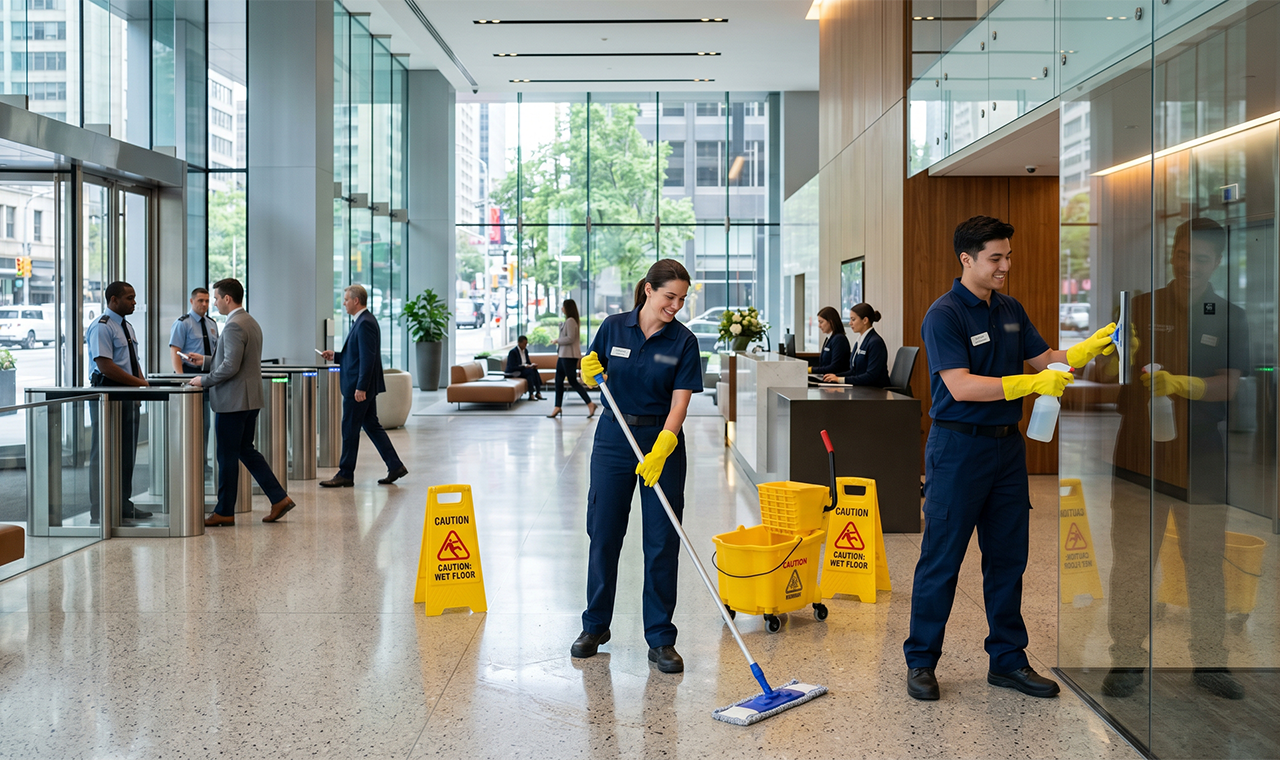
Commercial cleaning is a soft facilities management service, and it’s the most visible one your building has.
Cleaning Quote