

You can tell within a week when a cleaning programme isn’t holding. Overflowing bins by the lifts, smeared glass in reception, a washroom out of towels by mid-morning.
Home > Insights & News > What an ISO 9001 Cleaning Audit Actually Looks Like: Inside a Real Site Inspection

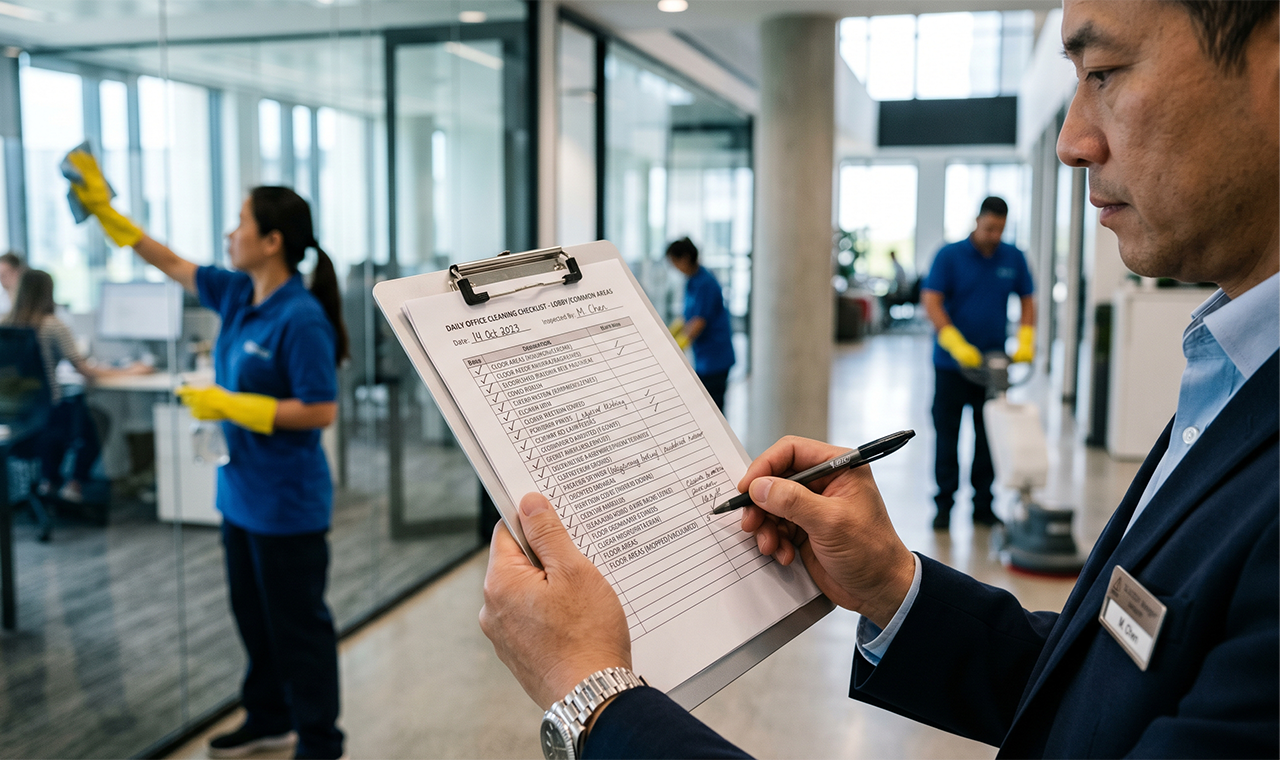
Most facilities managers never see a cleaning audit happen. A report arrives, it shows a score, and the contract carries on. Then standards slip, and you are the one explaining a number you never watched anyone measure.
A cleaning audit is a structured inspection. It measures cleaning performance against the standard your building is held to. Each audit produces scores, photographs, and a corrective-action trail. That trail is what separates a real audit from a number typed into a spreadsheet.
This article takes you inside a real ISO 9001 cleaning audit. You will see who runs it, how the zones are walked, how scoring works, and what happens when a deficiency turns up. By the end you will know what to ask your contractor for, and why the answer matters.
A real cleaning audit is scored against a defined standard and backed by photographs. Corrective actions are tracked to completion. ISO 9001 supplies the plan-do-check-act structure. If a contractor cannot show you scores, evidence, and a corrective-action trail, what they are doing is a spot check, not an audit.
A cleaning audit produces a documented record, not an opinion. The auditor scores each area, photographs deficiencies, and logs corrective actions. Repeated over time, those records show whether standards hold or quietly erode.
A spot check is different. It is a quick visual look around, usually unrecorded and unscored, limited to one area at one moment. An audit measures the whole site against an agreed specification, and it proves the result with evidence.
ISO 9001:2015, the international quality management standard published by the International Organization for Standardization (ISO), gives the audit its backbone. Its plan-do-check-act (PDCA) cycle treats cleaning as a managed process rather than a task list. You set the standard, deliver the service, check it through audit, then correct what falls short. The audit is the check stage. The corrective action is the act.
A revised edition of the standard is expected in September 2026, but the core PDCA logic of ISO 9001 is not expected to change.
In the UK, many providers build their criteria around the British Institute of Cleaning Science (BICSc). Its Outcome Criteria set out what an acceptable result looks like for each surface and facility type. Internationally, the ISSA’s Cleaning Industry Management Standard (CIMS) applies the same rigour at company level.

If your contractor cannot produce a scored, documented report backed by photographs, it is not quality control.
The auditor is typically a site supervisor, contract manager, or an independent quality lead. Credibility comes from using someone outside the team being assessed. FMA (the International Facility Management Association) recommends keeping the auditor independent of the cleaning crew for exactly this reason.
The cleaning team may attend so findings can be addressed on the spot. A client’s facilities manager sometimes joins, though attendance is not required.
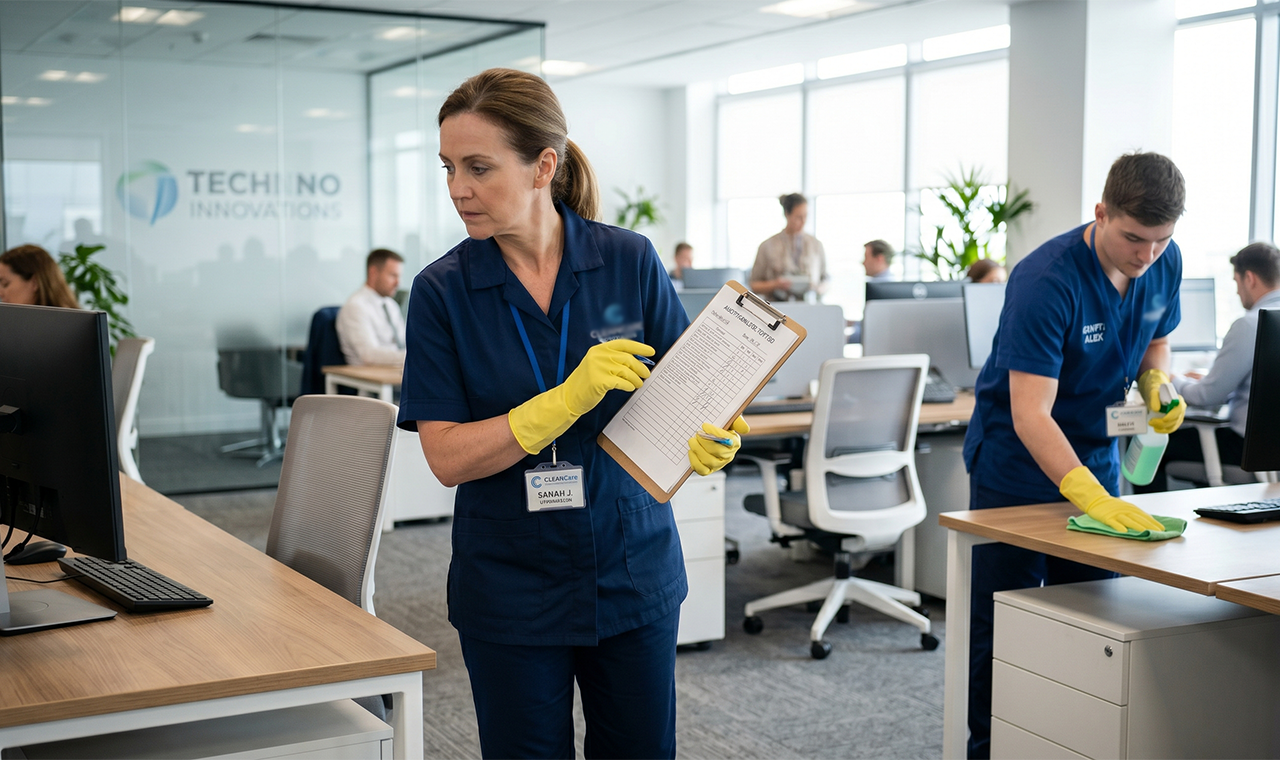
An auditor’s kit is deliberately simple. They carry the agreed checklist, a camera, and a mobile device running iAuditor, the digital audit platform The Clean Space uses. Scores, photographs, and corrective actions all land in one report, and the client can open it at any time.
Our page on how we monitor and audit cleaning quality walks through the full process.
No. Clients do not need to attend. They should still see the results through live digital reporting, not wait for a quarterly review meeting. If your contractor shares results only as a summary, that is a gap worth closing.
A cleaning audit reviews the same zones against the same criteria on every visit. That consistency is the point. Scores only compare month to month if the inspection scope stays fixed.
Most sites use the nationally recognised BICSc colour-code system to limit cross-contamination:

Washrooms carry the highest hygiene risk on most sites, which is why they sit under the red colour code. The auditor works through touchpoints systematically: sanitaryware, floors, drainage, consumables, dispenser levels, and any sign of odour. Each element is scored individually against the specification.
This is the zone where a commercial cleaning contract is most visibly won or lost.

Coded blue as low-risk space, offices look straightforward and rarely are. Desks, shared equipment, bins, and floors tend to score well at a surface glance. Keyboards, phone handsets, cable runs, and skirting boards are where points consistently disappear. Experienced auditors spend more time here than the casual observer would expect.
Kitchens take the green code because of food-preparation risk. The auditor checks sinks, worktops, appliance surfaces, floors, and waste handling. Contamination control is the governing concern throughout, not appearance alone.
These are the spaces visitors and staff actually move through. Floor presentation, glass panels, and reception surfaces are reviewed closely. A scuffed or dull lobby undermines the perception of an otherwise well-cleaned site.
Meeting rooms, waiting areas, and shared workspaces are scored on surfaces, furnishings, and floors. Turnover frequency matters here. A room used six times a day needs a different inspection lens than one used once a week.
These are the back-of-house spaces: bin stores, service corridors, and plant room surrounds. Less rigorous programmes skip them most often. Neglected utility areas breed odour, hygiene, and pest-control problems that surface elsewhere in the building.
Entrances are assessed for cleanliness, debris clearance, glass condition, and overall presentation. They are the first point of contact a visitor has with the building and the first thing an auditor checks on arrival.
Every inspected item receives a score. Item scores average into a zone score. Zone scores combine into an overall site percentage. That percentage is the figure that travels up to the client report and sits in the performance record.
A typical cleaning audit scale looks like this.
| Score | Rating | What It Means |
|---|---|---|
| 4 | Exceeds Standard | Exceptional condition, no deficiencies noted. |
| 3 | Meets Standard | Acceptable for the facility type and time since last service. |
| 2 | Below Standard | Deficiency present, re-service required within a set window. |
| 1 | Unacceptable | Visible contamination, health risk, or standard not met. |

This article stays inside the auditor’s inspection: the zones, the scoring mechanics, and the corrective-action trail. How those scores feed contract-level performance metrics is a separate, buyer-facing subject.
The Clean Space works to a red-amber-green (RAG) standard rather than a fixed numeric score. It runs weekly RAG reviews to track site performance and flag training needs. Any site that scores below its Amber standard gets immediate attention from an Operations Director.
Well-run UK contracts typically target an audit score in the 85 to 95% range. That is the benchmark The Clean Space sets out in its own cleaning performance KPIs guide.
Scoring models differ across the industry. The APPA cleanliness scale, from the Association of Physical Plant Administrators, runs in reverse. Level 1 is the highest standard and Level 5 the lowest. ISSA CIMS uses percentage thresholds instead. What matters is simple. The auditor, the contractor, and the client all read from the same scale.
Not on its own. A visual score tells you how a surface looks, not what is on it. On higher-risk sites, auditors add ATP (adenosine triphosphate) testing. The auditor reads a swab on a luminometer in seconds, and the result comes back in relative light units (RLU). A low RLU confirms the surface is hygienically clean, beyond what the eye can judge. Food production, healthcare, and laboratory contracts rely on this extra check.
A low RLU confirms a surface is hygienically clean, not just clean to the eye. That’s why food, healthcare, and laboratory contracts lean on it. The Clean Space, for instance, uses ATP testing where contamination risk runs highest.
A deficiency recorded in an audit starts a corrective-action sequence. Without that sequence, a low score is a complaint with no resolution path.
The corrective-action trail:
One low-scoring item can be an isolated miss. A cleaner had a difficult shift, or consumables ran short. A zone average that keeps falling short is different. It points to a structural problem, and it warrants a formal contractor review.

The Clean Space runs weekly site audits and weekly operative monitoring as standard. Monthly formal review meetings sit on top, to assess performance, raise concerns, and agree corrective actions. Supervisors run those audits in iAuditor, which keeps a real-time record everyone can see.
Broader industry guidance from IFMA points to formal audits at least monthly, with weekly checks in washrooms, food preparation areas, and healthcare spaces. Most practitioners also recommend weekly audits across the first 90 days of a new contract. That is when patterns and problem zones are still emerging. The facility-type table below reflects that wider industry guidance.

A genuine cleaning audit leaves a traceable trail: documented findings, scores, photographs, and corrective actions you can follow through to completion. A rubber stamp leaves only a number and no way to interrogate it.
Five signs that what you are receiving is not a real audit:
If more than one of those applies to your current contract, it is worth acting sooner rather than later. You can request an independent audit of your contract and we will tell you plainly what we find.
Open reporting is not good practice by convention alone. ISO 9001 clause 9.2 requires retained, documented evidence of the audit and its results. That requirement exists precisely because undocumented audits cannot be verified, challenged, or learned from.
You can see the pattern in the client’s own published results. At Francis Holland Schools, openly shared audits track an average cleaning audit score of 96%, alongside 99% of contracted hours delivered. Those figures are set out in the Francis Holland Schools case study. When a cleaning team knows the client sees every score, photograph, and corrective action, behaviour changes. Transparency is not a reporting feature. It is a performance driver.
A commercial cleaning audit is a structured, scored inspection of a building’s cleaning against an agreed specification. It produces a documented report with zone scores, photographs, and corrective actions. It is different from a spot check, which is visual and unrecorded.
The auditor walks each zone of the building in turn, scoring items against the cleaning specification. They photograph and log every deficiency. The client then receives the report, and each corrective action goes to a named person with a deadline. On an ongoing daily contract cleaning arrangement, this rhythm is built into the service rather than bolted on.
A commercial cleaning audit checklist covers every zone and surface type in the contract. That means washrooms, offices, kitchens, corridors, common areas, utility spaces, and exterior entries. Each zone has line items for surfaces, touchpoints, floors, waste management, and consumables. For a working template you can download, see the client’s office cleaning checklist resource, or the medical office cleaning checklist for healthcare settings. This walkthrough covers the audit process; those pages hold the downloadable checklists.
Items are scored individually, averaged into a zone score, and combined into a site-level percentage. The 1 to 4 model shown earlier is a typical industry scale; The Clean Space itself works to a red-amber-green standard. What matters is that the scale is defined in the contract and applied consistently.
The Clean Space runs weekly site audits with monthly formal review meetings. Broader IFMA guidance points to monthly formal audits as a minimum for most contracts. It also calls for weekly checks in high-risk zones such as washrooms, kitchens, and healthcare spaces. Higher-traffic or compliance-sensitive sites warrant more frequent inspection.
A corrective action is a documented response to a deficiency found in an audit. It names the problem, assigns responsibility to a specific person, sets a deadline, and requires a verified re-check before it is closed. It is not the same as asking a cleaner to go back and fix something. It is a tracked record with a sign-off requirement.
Yes. ISO 9001 clause 9.2 requires retained, documented evidence of audits. A contractor who summarises results verbally or holds them back until a quarterly meeting is not meeting that standard. You should have access to scored reports, photographs, and corrective-action status at any time.
A spot check is a quick visual inspection of one area, typically unscored and unrecorded. A cleaning audit covers the whole site, applies a defined scoring scale to every zone, produces photographic evidence, and logs corrective actions. Spot checks are a useful operational tool between audits. They are not a substitute for an audit.
A real cleaning audit does more than produce a percentage. It shows what was inspected, how performance was measured, and what was done when something fell short. The evidence is shared with the client rather than filed internally. That openness is what makes quality control real rather than administrative.
Want to see this in practice? Read about how we monitor and audit cleaning quality. Or get in touch about your own contract. That might be a full audit, a second opinion on a report, or an honest conversation about what your building needs.
An audit you never see is not quality control. It is decoration.

Head of Operations, The Clean Space
Colin Hawkins joined The Clean Space in 2025 as Head of Operations and sits on the Executive Team. His background spans senior leadership roles in hospitality and retail. He now oversees the operational divisions responsible for service delivery, team development, and client service standards. The audit and quality monitoring described in this article sit within the operations function he leads.
You can tell within a week when a cleaning programme isn’t holding. Overflowing bins by the lifts, smeared glass in reception, a washroom out of towels by mid-morning.
Most facilities managers never see a cleaning audit happen. A report arrives, it shows a score, and the contract carries on.
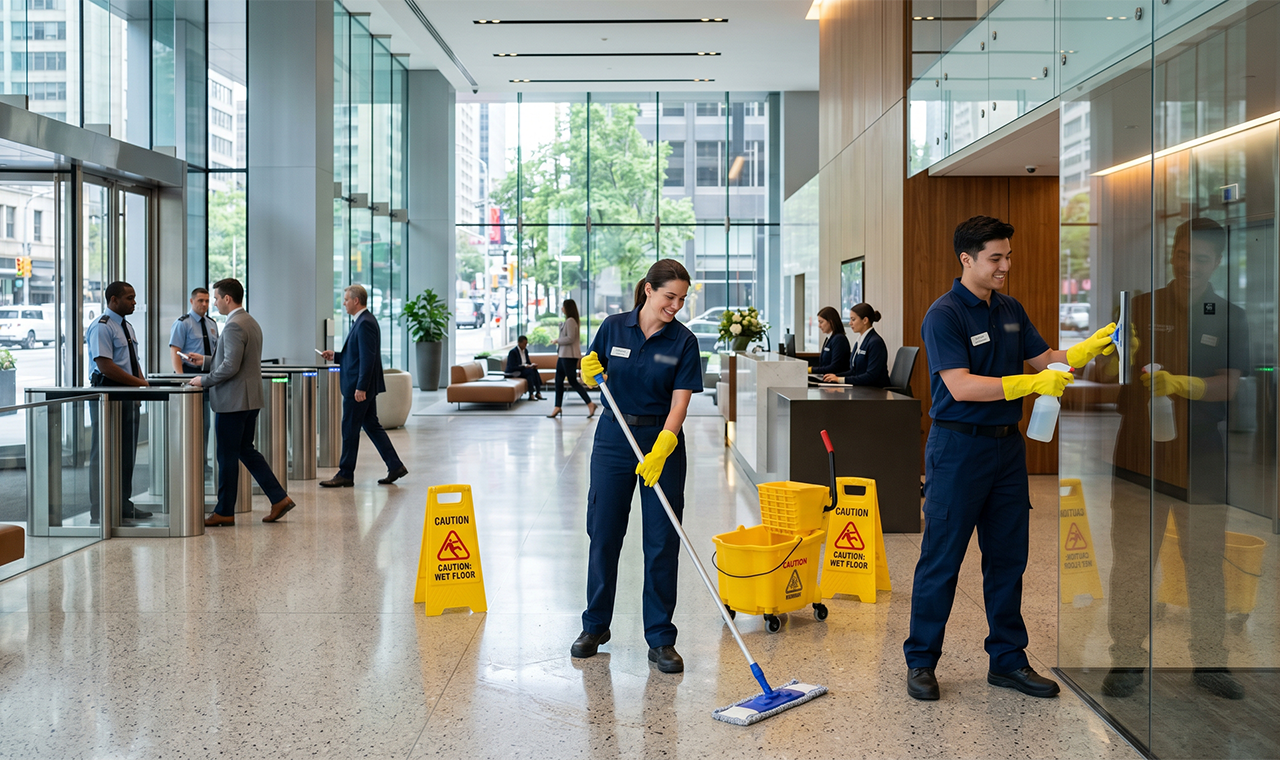
Commercial cleaning is a soft facilities management service, and it’s the most visible one your building has.
Cleaning Quote